Case study 01 · Operational transformation
Rebuilding Illinois Works around the participant journey
What began as a compliance recovery became a redesigned operating environment connecting participant progression, program delivery, staff ownership, required evidence, and state reporting.
Program context
Performance determined payment.
Illinois Works funds community-based organizations to recruit and prescreen participants, provide pre-apprenticeship training, and support their transition into registered apprenticeships in the construction and building trades.
Under its performance-based payment model, grantees earn payment by achieving and documenting defined participant milestones. That requires maintaining complete participant files, entering lifecycle data into IWRS, managing module-level attendance and stipends, reporting performance, and remaining prepared for monitoring and audit.
The program therefore had to do more than deliver training. It had to produce timely, verifiable evidence that each participant had reached each required stage.
01 · What I walked into
The records were incomplete. The operating problem was larger.
Construction & Trades Pathways operated within a state-funded workforce program governed by extensive grant, participant, reporting, and evidence requirements. Several completed cohorts had serious documentation gaps, and Illinois Works formally rated progress at 38%.
I entered without previous nonprofit, Illinois Works, state-funded workforce development, or grant experience. The first responsibility was to understand what had happened participant by participant and recover what could still be recovered.
Missing documentation was the visible problem. Program execution, evidence, reporting, and compliance had become disconnected.
The program relied on handwritten intake, manually scored interviews, scattered files, unofficial transcripts, and staff memory. Deficiencies were often discovered after the moment when they could have been prevented.
02 · How I learned the work
Return to the source.
I went back to the grant manual, state guidance, IWRS requirements, and original participant records instead of assuming inherited practice accurately represented the program.
- Reviewed individual participant profiles in IWRS
- Decomposed dense state red flags into specific deficiencies
- Mapped each missing or incorrect item to a participant and requirement
- Built a participant-level compliance matrix to track remediation
- Used the audit findings to locate recurring process failures
03 · The map I built
The participant lifecycle became the organizing architecture.
Rather than designing around separate tools or departmental habits, I mapped the work from first inquiry through post-program follow-up. Requirements, ownership, evidence, decisions, and information movement were assigned to the stage where they actually belonged.
One shared lifecycle connected participant progression, staff ownership, required evidence, operating statuses, reporting, and follow-up.
04 · How the model became operational
Technology followed the work.
The operating model became interconnected forms, rosters, reports, dashboards, shared reference data, status logic, automated requests, document generation, and preventive controls.
- Digital inquiry and conditional eligibility routing
- Controlled recruiting-to-program roster handoffs
- Attendance monitoring and stipend validation
- Participant-level compliance and exception visibility
- Milestone reminders and post-program outreach
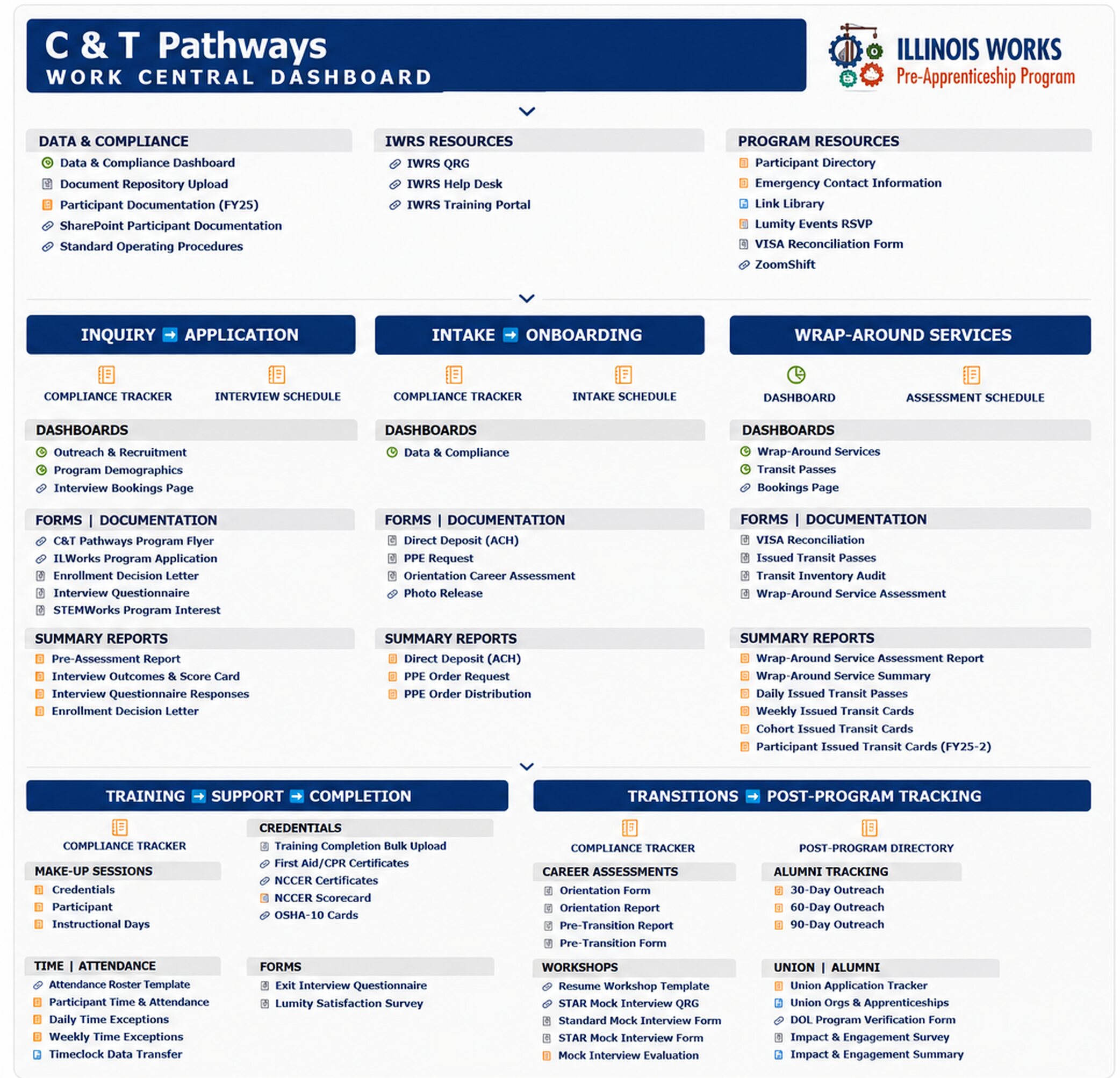
- Centralized program access through Work Central
05 · Evidence in practice
One place to understand and execute the work.
06 · Decisions and tradeoffs
The design had to survive beyond its designer.
The work model determined the structure. Smartsheet implemented it.
Requirements were moved upstream so preventable gaps surfaced before closeout.
Routine movement and reminders were automated. Eligibility, intervention, and participant support retained human decision-making.
Staff needed one understandable front door more than they needed to understand the architecture behind it.
07 · What changed
Recovery became prevention.
Historical compliance improved from 38% to 87% through participant-level reconstruction. The subsequent cohort, operating within the redesigned infrastructure and preventive controls, reached 96% at grant-year closeout.
The front door changed too. Monthly inquiries grew from 20 to 65, with approximately 600 prospective participants brought into one visible pipeline. Staff gained centralized access to requirements, participant progress, evidence, and next actions.
The value was not any single tracker, dashboard, SOP, or automation. It was the operating model connecting them.